Here's the church tower at St Pancras.

Here's a sculpture of Isaac Newton using a compass to measure the Universe - this is right in front of the British Library:

You know what I'm about to say about taking pictures inside, right? Good. I won't repeat myself then.
The library, just like the Bodleian in Oxford, is a copyright library, not a lending one. It holds a copy of everything printed or recorded in English in Britain. There are miles and miles of underground vaults that hold all this stuff, and they keep adding miles every year. Essentially, they're the UK's version of the Library of Congress.
You can apply for a reading card, provided you have some legit research purpose and can supply documentation and credentials.
So why bother going to visit it, you might ask?
Well...
They love to tease the public by displaying some of their holdings in a few dimly lit rooms, collectively referred to as the Ritblat Gallery. In these rooms, you can see (and hear) some amazing treasures.
There's Jane Austen's writing desk, for example, a small dark wood thing with slots at the top for pens and and ink bottle. On top of this is her handwritten manuscript for Persuasion, open to Chapter 24, as well a volume of her notebooks. Next to that is Charlotte Bronte's handwritten manuscript of Jane Eyre, opened to Chapter 38 ("Reader, I married him.").
There's a whole section devoted to Shakespeare, of course. Some of the earliest folios are here, as well as pieces by Marlowe, Donne, and Johnson.
I listened to recordings of William Butler Yeats, James Joyce, and Seamus Heaney reading from their work. Yeats read his "Lake Isle of Innisfree" as though he were almost chanting it, and his accent is wonderful.
I saw Oscar Wilde's handwritten edits to "The Ballad of Reading Gaol," a note written in Sylvia Plath's own, rather grade-school-looking, hand (fat letters with circles over i and j), and Virginia Woolf's handwritten notes for Mrs Dalloway.
You can also see handwritten Beatles lyrics - Help, Ticket to Ride, and Yesterday, specifically.
The Gutenberg Bible was impressive - not just because it was the first example of mass producing books, but also because of the illuminations decorating the pages.
Just beyond this was a case displaying pages from Leonardo da Vinci's notebooks. You can read his notebooks online, but it's not the same as seeing them with his drawings and doodles in them, and the writing in his own hand.
There's another little room dedicated to the Magna Carta. There are five or six copies in existence. This document is as important to the British as the Constitution and the Declaration of Independence are to Americans.
Down the hall from this gallery is an exhibit that focuses on T.S. Eliot, since he was recently voted Britain's favorite poet. Not bad for a Missouri-born man who didn't become a British subject until he was 39. I loved seeing his typewriter - one of three he owned in his lifetime. There's a piece of paper still in it. I remember reading Old Possum's Book of Practical Cats when I was a kid (love the drawings by Edward Gorey!). And then I read "The Lovesong of J Alfred Prufrock" in high school, and "The Wasteland" in college. Sometimes, it's hard to believe they were all written by the same person.
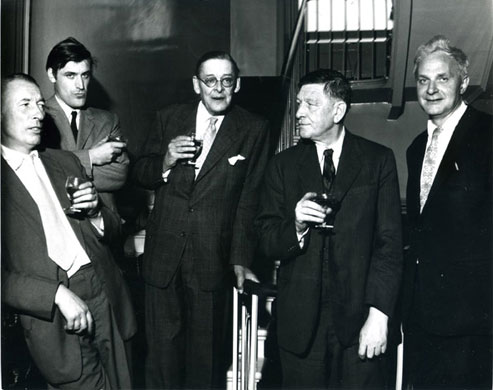
He worked for many years as editor for Faber and Faber. He was also a friend and mentor to Ted Hughes, whose writing I admire the more I read it. One famous photo shows Eliot and a young Hughes at a party with Louis MacNeice, WH Auden, and Stephen Spender. I wish the gift shop had had a postcard of that photo.
One of Ted Hughes' journals is displayed near this picture, and it's open to the page on which he recorded his reaction to the news of Eliot's death. He would have written this on 5 January 1965. Here's my transcription of it, as best I could get from his handwriting:
A told me casually "T.S. Eliot died yesterday" - like a crack over the head, exactly, followed by headache. Heavy aftereffects. I've so tangled him into my thoughts as the guru-in-chief, and dreamed of him so clearly and unambiguously that this will have consequences for me.
Another feature on display is the book collection of George III. The books are housed in glassed-in bookcases in the very center of the library, and the cases go up several floors (I think there are six floors in the library). George III willed his collection (65,000 printed volumes, pamphlets, manuscripts, and maps) to George IV, who bequeathed it to the nation, and it remains the library's "core," hence its placement in the center of the building.
I'm generally not one for gift shops, although I know the Doctor loves them and thinks every place should have one. However, I made an exception for the British Library's "little shop," because it was packed with books you won't often find at a regular bookstore. I managed to contain my purchases to Oscar's Books and The Hawk in the Rain and a bookmark, but there were so many others I would have gotten, had it not been for the thought of having to haul them back to the States in my luggage. I wonder if the Library of Congress has a gift shop...
I really thought I had a good handle on museums, having grown up visiting at least one Smithsonian museum every year on school field trips. And then I encountered the British Museum. I couldn't even get the building to fit in the viewfinder of my camera. It's like all the Smithsonians packed into one huge building. I only had an afternoon to see it, and almost immediately, I gave up on trying to see more than what was on the ground floor and first floor.
But guess what? You can take pictures inside! Yay!
One of the first things you see is the Rosetta Stone:

And then to the left and right are large rooms with Egyptian sculptures:


These heads are taller than a tall person, so imagine how big the entire statues would have been:

There were quite a few walls of Humerian relief sculptures:

Relief sculptures from the Parthenon, also referred to as the Elgin Marbles:

Greek statues:


Some Roman British archeological finds:

This was found near Dorset in Hinton St Mary:

I was too overwhelmed at this point and had to leave, especially after I walked through a room that looked like one of those old-time reading libraries with dark wood floor-to-ceiling shelves and display cases with all kinds of neat archeological finds. It would take an hour or two just to see everything in that room. I will need to come back and spend at least two days just wandering through this museum alone.
Since it was my last evening in London, I decided to have a look around the South Bank.
This is The George, one of the oldest pubs in London. Shakespeare and Dickens spent time here. Shakespeare probably even performed here in his early acting days.

Here's a better view of the replica of Francis Drake's ship, The Golden Hinde, in which he circumnavigated the globe. From what I've read, it was far from a pleasure cruise.

The remains of Winchester Palace (this is the west end of what was the Great Hall):

Kudos to whoever realized this was worth preserving.
There's a kitschy prison museum called The Clink - I had it on good authority that it wasn't worth going in:

I wandered through the Borough Market. There was so much to see (and eat) there. It reminded me of Lexington Market in Baltimore.
Shakespeare's troupe used the upper floor of this pub for dressing rooms and costume changes, before dashing next door to the original Globe Theater:

Speaking of which, The Financial Times building (the shiny building - you can just see the FT on the side of it) sits on what is thought to be the original site of the Globe Theater:

I tried to get tickets to see something at The Globe, but since I was visiting in the last days of their performance season, tickets were not as readily available as they would have been earlier in the season.
The cream-colored skinny building with the red door is Christopher Wren's house. He lived here while he was building London.

It just happens to have a great view of what he considered his greatest achievement - St Paul's Cathedral (as seen from the new Millenium Bridge):

I had dinner at the Ebury Wine Bar, which is next door to the hotel. Maple-glazed duck with spinach and mushrooms, and dark magenta-purple blackcurrant sorbet for dessert. Dee-lish!
Saturday morning, I had one last breakfast at the hotel, and then I caught the bus at Victoria Station to get to Heathrow.
So there you have it - my week-long tour of London. I saw just about everything I wanted to see, and I was glad I had a couple of out-of-town trips as well. The highlights for me were the British Library and Oxford. I'll definitely go back. And of course, now I need to see the rest of England. And Scotland. And Wales. And Ireland.
I realize the US has historical places and things to see, but nothing like what you'd find in England, where you can see things that are thousands of years old, not merely hundreds of years old.
Paris next year for my 35th birthday, I think.