Wednesday, December 30, 2009

2009 revolutions review

As I have done the past few years, I've pledged some revolutions at the beginning of the year, and then re-visited the list to see what I've accomplished at the end of the year. Revolutions work better for me than resolutions because there is less "should" and more "want to."

So here we go:

fun stuff

take cello lessons

I started lessons this summer with a fun/fab/philosophical teacher. It's turned into far more than I bargained for, but in a good way. I've let myself be a beginner at something again. And I've started listening to music with a more attentive ear in the same way that as a writer, I read others' writing with an attentive eye - I notice pattern and structure more than I used to.

And you want to know what mindfulness really means? Learn to play the cello. You've got to pay attention to your posture, the looseness (or tightness) of your shoulders and arms, your bow grip, the angle of the bow across the strings, the position of your wrists over the bow and the fingerboard, which notes are played where on the fingerboard, the sound of the notes as you play them (cello is a fretless instrument, therefore, you only know if you're playing the note correctly by how it sounds), tempo and rhythm, loudness or softness, and a ton of other things all at the same time. It's an amazing form of meditation trying to keep all that in focus.

repaint and wallpaper the doll house

Poor neglected doll house. I've changed my mind on the color scheme for the outside of it so. many. times. Someone suggested getting paint samples that come in the little cans, which I think is a good idea. So this goes on the 2010 revolutions list.

join a knitting group

This was almost too easy. I had no idea there were so many knitting groups in the area (an Interwebtube search found them all for me). The one I picked has about 300 members and has three meetings each week to accommodate schedules. Not everyone goes to all the meetings, and some can only make an occasional meeting. I usually go to the Saturday session, which has about a dozen people usually. No formal structure. No dues or fees. Just show up, sit down, and knit. And I love this group of knitters! There's a lot of diversity in age range, family background, career background, and craft experience. The conversations are sometimes serious, sometimes hilarious, sometimes bizarre. And it's not a quiet or meek little group. We can get rowdy! It's definitely something I look forward to on Saturday mornings.

knit or crochet something different

I've gotten a lot braver with my projects this year. I made a cabled messenger bag (and lined it thankyouverymuch), a sleeveless top, and a cardigan. I'm now working on my second cardigan.

The challenge project was Angel's crocheted babette blanket. Making all the squares was easy, and I thought assembly would be easy too, since the pattern provides a diagram of what size square goes where. However, I've never sewn up a project this big before, and my artist's eye is (overly) conscious of evenly distributing the color scheme across the blanket. And it takes longer to sew up blocks than you might think, especially trying to get edges to match up nicely and making sure seams aren't lumpy. It's coming along though, just far more slowly than I had anticipated (sorry, Angel!). So this one goes on the 2010 list, too.

book indulgence (to make up for all the books I put off reading because of the last two years of grad school)

My reading has been all over the place this year, and I've revisited some books and series, like Margery Allingham's Albert Campion series (he and I have the same birthday! albeit 75 years apart), and the to-be-read stack gets pleasingly bigger all the time.

I'm about halfway through Sense and Sensibility and Sea Monsters (thanks, Joe!), which I've been reading at night before bed, and on a couple of occasions, has provided me with odd dreams of a tentacle-faced Alan Rickman playing the cello (see him in S&S and Truly Madly Deeply, and you might understand this).

Then I've got Her Fearful Symmetry ('cause I liked The Time Traveler's Wife so much), and The Children's Book, and a couple more by Kate Mosse, and the Ted Hughes anthology and the book about Oscar Wilde's library (both of which I got while in London in October), and a bunch more that I can't remember right off. I have quite enough on the to-be-read list to keep me going well into 2010.

writing

write another novel

This turned out not to be a children's book, which is what I had anticipated doing and had an idea for. Instead, a contemporary fiction-style story came out, which is still a mystery to me. But I was able to work on regularly, and the first draft is nearly finished. I don't love or hate it. It was just there, and I wrote it down. I may revise it. I may just chalk it up to "writing experience."

revise and send off novel/thesis to agents

Still querying, still getting rejections or silence. Not much else to say about it.

participate in NaNoWriMo in November

See above re: contemporary fiction story. I felt rusty after not having done this for two years, and perhaps that's why the story isn't doing much for me; rather, it was just practice. I managed to get to 50,000 words with a couple of days to spare. The story wasn't finished though, so I kept working on it through December, a little bit every morning. It's closer to 90,000 words now.

health

get off Lexapro

This was the hardest thing I did this year - not just dealing with the physical withdrawal symptoms, but also facing my mental dependence on a pill to keep The Monster away. It was more painful and discouraging than I could have imagined, especially the 3-month headache that no amount of Advil could take care of. That I managed to keep myself functional enough to work is a miracle. There were days were the goal was to just get through the day without crying and running back to the pills again. But I'm free of it finally, and so much more clear-headed and energetic, and I've only had a few panicky blips now and again. Blood tests showed I was severely low on a few minerals and vitamins, deficiencies that are probably due to the Lexapro and which can cause panic attacks, ironically. I take a cocktail of supplements every morning now, but they're not interfering with my sleep or my energy levels or my thinking ability (quite the reverse, actually), so I don't mind.

For the record, I think short-term use of pharmaceuticals under a doctor's supervision is fine to get one functioning again. Dependence on them to keep you going without making any effort to find better solutions and healthier coping mechanisms is not fine. I was on Lexapro for two years because I fell into the dependence trap, and it was frustration with lack of energy and lack of creativity that forced me to do something about it. The pills did keep the panic attacks away, but I still didn't feel good. I was only not panicking. That's not a fair swap.

lose Lexapro weight

One doctor told me that the reason people gain weight while taking SSRIs is because of the way the pill makes the body pull on minerals, particularly from the thyroid, which explains the deficiencies that showed up in the blood tests. A bit of weight has come off, which I attribute to having more energy to get outside and walk and the lack of severe carb cravings that I had while on the wretched pills. I'm trying to be reasonable about this - I'm not asking to be a size zero, just a size smaller than I am now. This also goes on the 2010 list.

follow Karen-the-acupuncturist's protein and greens advice

Karen suggested this to help ease the withdrawal symptoms as well as to help the weight loss - better body and brain food than the empty carbs I was addicted to. I have done pretty well with this, especially when I started my Sunday afternoon ritual of making kale and chickpea soup (I use spicy chicken sausage instead of the chorizo) as well as salmon and vegetables in the slow cooker. This will continue into 2010. I just need to find more recipes.

try EMDR therapy to prevent the panic attacks

I didn't get to this, mostly due to its expense (and lack of reimbursement from the health insurance) and the nearest practitioner is in Towson, which is a hike from where I am. If you want to know more about EMDR, try here. I haven't decided if I want to carry this over into 2010 or not.

money

save money for London trip

The money I saved up went toward the plane tickets, hotel, meals, and a Tube pass. I'm not big on souvenirs, so other than a couple of boxes of tea and toffee and a few books, my souvenirs were more photographic in nature. I had a fabulous time in London, and will be passing through it again on my way to Paris in May. So the 2010 version will be saving money for that.

replenish savings account

I had a lot of reimbursement checks this year, so those went into the savings account along with the monthly auto deduction from my checking account.

pay extra on mortgage

I made one extra payment this year. I would have liked to have made more payments, but there it is.

Not a bad showing for the year. I also added less news watching/reading because it just got more and more depressing as the year trudged on.

My 2010 revolutions list is small, but the goals are broader. More on that in another post.

Tuesday, December 1, 2009

the muse oddly delivers; the internal editor is puzzled

(Hmm, that headline reads like one of the subtitles of the later Steed-and-Peel Avengers episodes.)

Anyway. I made it to 50,000 words on November 27th, and I didn't even do it perfectly.

My goal was to write 2000 words a day in November, in anticipation of the inevitable slumps that occur mid-novel and other Life stuff that often gets in the way. This meant there were days when it was a feat just to get 500 words written. Most of the time, I was able to keep up with this daily word count, mainly because I am a morning person, so I could get most of it done before going to the day job. Dr Wicked's Write or Die software helped immensely, too. The thought of being subjected to That Earworm-inducing Hanson Song if I stopped typing for more than a few seconds was enough to keep me, well, typing.

My best writing session occurred on November 21st, between 7 and 10 pm. I went to a cello concert at a local church. They have an amazing music program and regularly feature guest performers. This concert featured Steven Doane, who is a world-class cellist. He played Bach, Poulenc, and Brahms. I scribbled in the notebook I'd brought with me while he played, and when I went home and typed it, it was just over 1500 words!

Having participated in NaNoWriMo twice before, my internal editor was at least familiar with the process, even if he is still bewildered by it. Have I ever told you about him? He's slightly taller than me, and quite good-looking with very dark hair, almost black, and he usually wears a dark turtleneck and khaki pants. His shoes are always polished. He sits in a high-backed chair near a window with the sun coming through and making a nice pattern on the hardwood floor in an otherwise empty room. I'm not sure where he came from or why he picked me (or got stuck with me), and I still don't know his name. And although he's wary of this high-speed drafting process, even after witnessing it three times, he's at least willing to sit and read and wait in the corner because he knows there will be a substantial draft for him to pore over and fix soon. He loves that bit.

My muse, on the other hand, is a little girl. Sometimes she wears a dress; sometimes she's in a t-shirt and overalls and tennis shoes. She wears her hair up in pigtails with either outfit. She's always playing with something - dolls, train set, paints, legos, lincoln logs. I once found her attempting origami, but she was using construction paper, which wasn't working out too well. Her room is well-lit with plush carpet. Toys are scattered everywhere, and the shelves along the walls are all full of more fun stuff to fiddle with. I don't know her name either. I do know that if I show up on a regular basis, she's more willing to show up, and as long as there's something to play with, she'll feed me ideas. The internal editor looks on from his room next to hers, and I see him shake his head sometimes at what she comes up with. She doesn't think in terms of boundaries or plausibility. She just tosses out ideas and gives me a "take it or leave it" look.

This time, she gave me a realistic story. No fantasy. No ghosts. No magic. Just a this-could-really-happen story. The internal editor and I kept glancing at each other during the plotting process. This isn't the sort of thing I write. Jane Austen and a few other things aside, most of what I read has some sort of out-there twist on reality, hence its influence on my writing. Contemporary fiction just isn't my thing. But there was that "take-it-or-leave it" look, so what could we do?

I think the reason she did this was because I was out of practice with speed writing. I've spent the last two years writing from an academic, analytical point of view for my master's degree - even though it was a creative writing degree, there was a lot of scrutinizing how things were written - and a large part of that time was spent on my thesis, which was a big revision of my first NaNoWriMo novel. Rather a slow process all around.

I think she wanted to ease me back into the process. This real-life story is as basic as it gets - how things are, what causes them to change, struggle with the change, make decisions and take actions to deal with the change, what effect has it all had in the end. She wasn't having any of this layer of magical realism and whatnot.

Even though I had the whole thing plotted out ahead of time, I still started November doubting that I'd make it to 50,000 words by the end of the month with this story. Without that layer of twist, which perhaps I rely on too much, I worried that I'd run out of story too soon. But nearly every day, I managed 2000-ish words, and although I got to 50,000 words before November ran out, there was still a sizable chunk of story to tell. Since the average novel length is around 90,000 words, I'm not concerned that I didn't get it all down in 50,000 words. Amazed, yes. But not concerned.

So I'm spending December adding the other 40,000 words, which is only about 1300 words a day. I think I can comfortably finish the story in that amount of words and time, and it keeps my morning writing routine going anyway.

Weirded out by the whole experience, but we're managing.

Saturday, November 7, 2009

third time's charming so far

Right. I'm a week into my third NaNoWriMo outing. I've been able to keep up with about a 2000-words-a-day writing goal. I do this solely because I know I will come to a dragging point somewhere in this month where I either won't feel like writing or can't get the words out or get bored or get stuck, so may as well get ahead now in anticipation of The Slump.

I'm a bit more tool-oriented with this attempt. I've been using Dr. Wicked's Write or Die software to do 500-word sprints, which makes getting to 2000 words a day that much easier. It gives real-time word counts as I type. It keeps me focused on getting words down and doesn't allow for distractions. Thank you, Dr. Wicked.

I did a lot of prep work - character bios, plot storyboards, and research - which helped me come up with more detailed characters and storylines. I wish I were a pantster like Joe-the-office-roomie is (oh, how I envy him!). But I'm not. I gotta plan. In fact, I nearly filled up an entire notebook with notes for this novel.

I'm posting my word counts on Twitter every day, too. Nothing like accountability to get one's fingers on the keyboard.

I also came across this great post about how to get the writing done. It's helpful, funny, and a bit, um, salty, in the language. I got my sprints idea from this article.

I've already noticed a few things about this attempt. In some ways, it's easier. I've done this twice before. I know how long it takes me to get out 2000 words a day. I know my procrastination tendencies. I know where I tend to get stuck in plots and ways I can get unstuck.

In other ways, it's harder. Coming up with yet another story. Grappling with an ever-more-vigilant internal editor (there are downsides to MFA training). Trying to make sure I don't neglect cello practice.

And speaking of cello practice, it plays a large part in my story. As does Oxford. Two things that have made recent and strong impressions on me, although I'm still working out why that is. It's not quite "write what you know." It's more "write what you learn about and recently discover that holds your attention and enthusiasm." Karen-the-acupuncturist thinks that since I have British ancestors through my mom's family, something may have got jangled/resonated/woken up in my DNA while I was in the UK. It could happen. It could also be that I've been listening to too many Jacqueline du Pre recordings. She was an extraordinary cellist and was born in Oxford.

And in a lot of ways, it's different. Now that I'm on the completed side of an MFA degree, I scrutinize stories more than ever for pacing, plot, and how well description is balanced with action and dialogue. This is helpful as far as making sure all these things are covered, and hopefully will make revision easier. It does take a drop of fun out of it, though.

I'm pushing myself to write longer and more complex scenes. Really digging in for a complete picture of what's going on. I think having done all the detailed story planning has helped with this.

I can also tell as I work on this piece that I am a description junkie. I need a strong sense of character background and setting to feel anchored and oriented in the story (and I've always liked the adage, "write what you want to read"). This is probably why A.S. Byatt's Possession is one of my favorite books. Every character has a detailed back story that you get to read in the novel. Not to mention all the detail about research in academia. Some people find this tedious reading. I think it's fascinating. Probably too much so. But even now, I still find it hard to believe that Ash and Christabel don't actually exist. That's how well-written these two fictional Victorian poets are in the story. I think all the detail and description works in Possession because it's relevant to the story. I've adopted that as a writing strategy - I'm allowed to write all the backstory and description I want, provided it's relevant to the story. (I'll probably take half of it out during revision anyway.)

And finally, this year's attempt is contemporary fiction. And serious and slightly depressing contemporary fiction at that. No fantasy, no ghosts, no science fiction, no magical realism. That's a new one for me. And yet, I still want to write this story, so there must be something to it, right?

Oh, and there's something else.

Perhaps it's because I've been on hiatus for two years, but I'm noticing a lot of backlash to NaNoWriMo. "It's not 'real' writing." "A gazillion wannabe writers writing bad fiction which makes 'real' writers look bad." "Do these people have nothing better to do this month?" And those are the tame ones.

Hmm, I never realized that writing, or in a larger sense, creativity, was an elitist thing that only certain people should be allowed to do. I must have missed that.

I think NaNoWriMo is so appealing to people because it's accessible and fun. There are 152,897-and-counting people making an effort to write a story this month. Think of how much collective creative energy that is! And the organizers get big-name writers to write pep talks to e-mail to participants - people like Tom Robbins, Sue Grafton, Neil Gaiman, Philip Pullman, Katherine Patterson, Meg Cabot, Jasper Fforde. And quite a few people have revised and published their NaNoWriMo projects. (And no, not self-published; we're talking published by Harper Collins, Ballantine, Berkeley, Penguin, and Simon & Schuster, among others.)

People have all kinds of reasons for doing something like this. Some might have always thought they "had a book in them." Some might just want to check it off their bucket list, and could care less about revising it and getting it published. Some might be curious to see how hard it is to do. Some may have internal editors that are that mean and nasty and have made them stop writing novels countless times, and they hope this is the way to finally get as much of it written as possible, especially with the kind of support you get from the organizers and fellow writers. Some may be trying to quit cigarettes or alcohol or drugs and need a distraction. Some may be unemployed and need to feel like they're taking an action instead of letting themselves get worried or depressed. Some may have just found out they have cancer or some chronic or degenerative disease or that a relative has died and they need to take their minds off it or they need to write about it so they don't go crazy. Some might be trying once and for all to squash the voice of their 7th-grade teacher or their parent who said they were a bad writer and want to show them a thing or 50,000. Some may just want to write a story for their children or their family or for the kids they teach. Some may do it because their kids are doing it through the Young Writers Program and they've devised some sort of treat they'll enjoy together if they both finish. They're all valid reasons.

I first tried it in 2005 because I had just broken up with a boyfriend. I needed to take my mind off it. I didn't want to be lying in my darkened bedroom for weeks on end. I didn't want to turn into a binge eater. I didn't want to mope and drive my family and friends crazy. So I wrote a ghost story instead. I felt like that much less of a failure after 50,000 words came out in a month. In fact, I cried once I'd passed the 50k mark. And I became addicted to writing. I participated in NaNoWriMo in 2006, and then I took a two-year break to work on my MFA. My advisor was all for me taking my 2005 draft and turning it into my thesis. I added 40,000 words to it, and revised and rearranged and fiddled with it. I now have a hefty university-printed version, and the manuscript is making its way electronically in the world. No takers yet, but I'm hopeful.

I didn't do it the first time because I wanted to write a novel that I could eventually publish. I did it because I needed help to get through my pathetic and unimportant-to-everyone-in-the-world-but-me little heartbreak. And it worked. Someone's actually going to tell me I had no business doing this because my reason wasn't good enough? Seriously?

What can anyone possibly have against a bunch of people who want to have a creative fling for a month? I say let 'em have fun with literary abandon!

How is everyone else's story coming along during NaNoWriMo 2009?

Sunday, October 18, 2009

AoC - Day the Sixth: in which I decipher illegible handwriting and poke around in England's attic

I spent Friday morning at the British Library, which is near St Pancras station.

Here's the church tower at St Pancras.


Here's a sculpture of Isaac Newton using a compass to measure the Universe - this is right in front of the British Library:


You know what I'm about to say about taking pictures inside, right? Good. I won't repeat myself then.

The library, just like the Bodleian in Oxford, is a copyright library, not a lending one. It holds a copy of everything printed or recorded in English in Britain. There are miles and miles of underground vaults that hold all this stuff, and they keep adding miles every year. Essentially, they're the UK's version of the Library of Congress.

You can apply for a reading card, provided you have some legit research purpose and can supply documentation and credentials.

So why bother going to visit it, you might ask?

Well...

They love to tease the public by displaying some of their holdings in a few dimly lit rooms, collectively referred to as the Ritblat Gallery. In these rooms, you can see (and hear) some amazing treasures.

There's Jane Austen's writing desk, for example, a small dark wood thing with slots at the top for pens and and ink bottle. On top of this is her handwritten manuscript for Persuasion, open to Chapter 24, as well a volume of her notebooks. Next to that is Charlotte Bronte's handwritten manuscript of Jane Eyre, opened to Chapter 38 ("Reader, I married him.").

There's a whole section devoted to Shakespeare, of course. Some of the earliest folios are here, as well as pieces by Marlowe, Donne, and Johnson.

I listened to recordings of William Butler Yeats, James Joyce, and Seamus Heaney reading from their work. Yeats read his "Lake Isle of Innisfree" as though he were almost chanting it, and his accent is wonderful.

I saw Oscar Wilde's handwritten edits to "The Ballad of Reading Gaol," a note written in Sylvia Plath's own, rather grade-school-looking, hand (fat letters with circles over i and j), and Virginia Woolf's handwritten notes for Mrs Dalloway.

You can also see handwritten Beatles lyrics - Help, Ticket to Ride, and Yesterday, specifically.

The Gutenberg Bible was impressive - not just because it was the first example of mass producing books, but also because of the illuminations decorating the pages.

Just beyond this was a case displaying pages from Leonardo da Vinci's notebooks. You can read his notebooks online, but it's not the same as seeing them with his drawings and doodles in them, and the writing in his own hand.

There's another little room dedicated to the Magna Carta. There are five or six copies in existence. This document is as important to the British as the Constitution and the Declaration of Independence are to Americans.

Down the hall from this gallery is an exhibit that focuses on T.S. Eliot, since he was recently voted Britain's favorite poet. Not bad for a Missouri-born man who didn't become a British subject until he was 39. I loved seeing his typewriter - one of three he owned in his lifetime. There's a piece of paper still in it. I remember reading Old Possum's Book of Practical Cats when I was a kid (love the drawings by Edward Gorey!). And then I read "The Lovesong of J Alfred Prufrock" in high school, and "The Wasteland" in college. Sometimes, it's hard to believe they were all written by the same person.

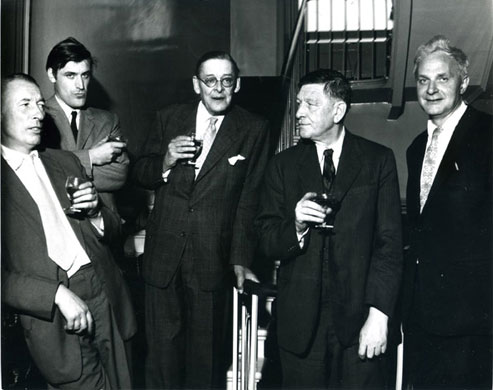
He worked for many years as editor for Faber and Faber. He was also a friend and mentor to Ted Hughes, whose writing I admire the more I read it. One famous photo shows Eliot and a young Hughes at a party with Louis MacNeice, WH Auden, and Stephen Spender. I wish the gift shop had had a postcard of that photo.

One of Ted Hughes' journals is displayed near this picture, and it's open to the page on which he recorded his reaction to the news of Eliot's death. He would have written this on 5 January 1965. Here's my transcription of it, as best I could get from his handwriting:

A told me casually "T.S. Eliot died yesterday" - like a crack over the head, exactly, followed by headache. Heavy aftereffects. I've so tangled him into my thoughts as the guru-in-chief, and dreamed of him so clearly and unambiguously that this will have consequences for me.

Another feature on display is the book collection of George III. The books are housed in glassed-in bookcases in the very center of the library, and the cases go up several floors (I think there are six floors in the library). George III willed his collection (65,000 printed volumes, pamphlets, manuscripts, and maps) to George IV, who bequeathed it to the nation, and it remains the library's "core," hence its placement in the center of the building.

I'm generally not one for gift shops, although I know the Doctor loves them and thinks every place should have one. However, I made an exception for the British Library's "little shop," because it was packed with books you won't often find at a regular bookstore. I managed to contain my purchases to Oscar's Books and The Hawk in the Rain and a bookmark, but there were so many others I would have gotten, had it not been for the thought of having to haul them back to the States in my luggage. I wonder if the Library of Congress has a gift shop...

I really thought I had a good handle on museums, having grown up visiting at least one Smithsonian museum every year on school field trips. And then I encountered the British Museum. I couldn't even get the building to fit in the viewfinder of my camera. It's like all the Smithsonians packed into one huge building. I only had an afternoon to see it, and almost immediately, I gave up on trying to see more than what was on the ground floor and first floor.

But guess what? You can take pictures inside! Yay!

One of the first things you see is the Rosetta Stone:


And then to the left and right are large rooms with Egyptian sculptures:


These heads are taller than a tall person, so imagine how big the entire statues would have been:


There were quite a few walls of Humerian relief sculptures:


Relief sculptures from the Parthenon, also referred to as the Elgin Marbles:


Greek statues:


Some Roman British archeological finds:


This was found near Dorset in Hinton St Mary:


I was too overwhelmed at this point and had to leave, especially after I walked through a room that looked like one of those old-time reading libraries with dark wood floor-to-ceiling shelves and display cases with all kinds of neat archeological finds. It would take an hour or two just to see everything in that room. I will need to come back and spend at least two days just wandering through this museum alone.

Since it was my last evening in London, I decided to have a look around the South Bank.

This is The George, one of the oldest pubs in London. Shakespeare and Dickens spent time here. Shakespeare probably even performed here in his early acting days.


Here's a better view of the replica of Francis Drake's ship, The Golden Hinde, in which he circumnavigated the globe. From what I've read, it was far from a pleasure cruise.


The remains of Winchester Palace (this is the west end of what was the Great Hall):


Kudos to whoever realized this was worth preserving.


There's a kitschy prison museum called The Clink - I had it on good authority that it wasn't worth going in:


I wandered through the Borough Market. There was so much to see (and eat) there. It reminded me of Lexington Market in Baltimore.

Shakespeare's troupe used the upper floor of this pub for dressing rooms and costume changes, before dashing next door to the original Globe Theater:


Speaking of which, The Financial Times building (the shiny building - you can just see the FT on the side of it) sits on what is thought to be the original site of the Globe Theater:


I tried to get tickets to see something at The Globe, but since I was visiting in the last days of their performance season, tickets were not as readily available as they would have been earlier in the season.

The cream-colored skinny building with the red door is Christopher Wren's house. He lived here while he was building London.


It just happens to have a great view of what he considered his greatest achievement - St Paul's Cathedral (as seen from the new Millenium Bridge):


I had dinner at the Ebury Wine Bar, which is next door to the hotel. Maple-glazed duck with spinach and mushrooms, and dark magenta-purple blackcurrant sorbet for dessert. Dee-lish!

Saturday morning, I had one last breakfast at the hotel, and then I caught the bus at Victoria Station to get to Heathrow.

So there you have it - my week-long tour of London. I saw just about everything I wanted to see, and I was glad I had a couple of out-of-town trips as well. The highlights for me were the British Library and Oxford. I'll definitely go back. And of course, now I need to see the rest of England. And Scotland. And Wales. And Ireland.

I realize the US has historical places and things to see, but nothing like what you'd find in England, where you can see things that are thousands of years old, not merely hundreds of years old.

Paris next year for my 35th birthday, I think.

Thursday, October 15, 2009

AoC - Day the Fifth: in which I see how the royal half lives

I spent all of last Thursday in Windsor and Eton. It takes about an hour to get to the Riverside or Central train stations from the Waterloo train station. Another 12 pounds well spent.

I saw this amusing sign at the Windsor station:


There's no escaping Jane Austen. I gave up years ago.


You can see the castle from the train station, and it's only about a 10-minute walk to get to it.


It's definitely not isolated with acres of empty fields around it. The village is right across the street:


The Queen says she considers Windsor her home. I found it to be too imposing-looking and museum-like to be a home (I suppose that shows you how of-the-people I am).


As per routine, no pictures allowed inside.

My first stop was Queen Mary's Dollhouse. It's a palace in miniature. The lights and faucets and elevators ("lifts") all work. Many of the pieces inside it are handcarved, handmade, and use materials like marble or silk.

Also in this display room, you can see two 3-foot-tall dolls that were given to then-Princess Elizabeth and her sister Margaret by the children of France. Each doll has her own traveling trunk and a full wardrobe of underclothes and dresses - all handmade, I'm sure.

The royal family's art collection isn't too shabby either - a DaVinci drawing or two and Michelangelo's drawings of royal ancestors are some of the highlights.

They even have their own chapel, which really looks like a full-size church. This is just part of it:


The Queen's parents and grandparents are buried here, along with her sister, Princess Margaret, as well as many other kings, queens, princes, and princesses. Henry VIII is buried with his favorite wife, Jane Seymour (the one who gave him a son who actually lived).

To say the royal family owns a lot of stuff is an understatement. The castle is cluttered with swords, guns, paintings, armor, furniture, statues, and china.

The town is cute and has lots of shops and cafes. I stopped for a roast chicken and chips lunch before going to check out the village of Eton.


The villages of Windsor and Eton are right next to each other, separated by a footbridge going over a cleaner part of the Thames.


And a cleaner Thames:


School was in session at Eton College, and the boys didn't seem at all fazed by all the tourists in the town. Why they should have to dress in tailcoats to sit in a classroom is beyond me.

Eton village looks a lot like Windsor village, but less crowded.


The college was closed to visitors for the season, but I did manage to get this bit of it:


There are a lot of other day trips you can take from London besides Oxford and Windsor - you could go to Cambridge, Greenwich, Bath, and even Paris.

I had dinner back in London at Jenny Lo's tea house, which is just down the street from my hotel. I had a yummy plate of Singapore noodles and a cup of green tea. They put the tea leaves right in the cup, and it's drinkable when the leaves sink to the bottom and you can pick up the cup (no handle on it) without burning your fingers.

Two more stops in tomorrow's post.

Wednesday, October 14, 2009

AoC - Day the Fourth: in which I climb a lot of stairs and get very soggy

I forgot to mention in yesterday's post that it costs 12 pounds (about $19 as of this writing) to tour the War Rooms, and it's free to get into the National Gallery.

Onward.

Sometimes life requires a high-protein breakfast, especially when you're up and around, out and about all day long. The Lime Tree Hotel serves what might at first look like a heavy breakfast, but is actually just what you need for a day out - you never know what you may take a fancy to doing, as you will soon see.

The hotel's traditional breakfast includes a scrambled or poached egg, bacon (more like Canadian bacon than the streaky, fatty stuff), a small sausage link, and a side of vegetables, usually mushrooms or grilled tomatoes, plus toast, orange juice, and tea or coffee. All of it served hot and fresh sent up on the dumb waiter from the basement kitchen. And the British are so much more reasonable about portion sizes. You get just enough on your plate to fill you up, but you don't feel overstuffed.

Since a lot of people were staying at this hotel at the time (lower off-season room rates, you know), I never knew whom I'd be sitting with in the cute breakfast room (the brown wallpaper with the Georgian silhouetted faces just teetered between tacky and charming, and the placemats displayed Victorian renderings of some of the famous sites in the city). One of my breakfast companions was a retired gentleman whose wife died of cancer last summer. They had always traveled together. This was his first trip without her, and his five daughters were nervous about him traveling alone. I'd say he was heartier than they gave him credit for. Another couple, a semi-retired civil engineer and his wife, were traveling all over the UK , and had stopped in London for a week. They told me all about sitting on a rock near Hadrian's Wall, eating bacon sandwiches. Another family had "come up from the country" to spend a week "in town." Apparently, if you say you're "going up to town" in the UK, it means you're going to London.

Thus sated with protein, I spent the morning at St Paul's Cathedral. There's a 10-pound (about $16 as of this writing) entry fee. Sigh, no pictures allowed in this one either. But here's the outside:


And here's a statue of Queen Anne, who was ruling when the church was completed.


Here's its garden side:


Five churches have occupied this site over the centuries, the first in 604. Christopher Wren designed the current one. Originally, he was commissioned to repair the previous one, even though he wanted to tear it down and start from scratch. He was overruled, but then the Great Fire of 1666 overruled those who overruled Wren, so he got his way in the end because the old church burned down. Wren's version is open and spacious and light inside the cathedral, whereas Westminster Abbey feels a little cramped and dim, despite its size. The nave doesn't have any adornments or paintings on the ceiling, per Wren's design. But those Victorians just can't leave well enough alone, and they added (some say, overdid) decorative elements near and around and above the high altar later. The ceiling mosaics look as though they're glittering - in fact, the tiles are set at angles to catch the light.

St Paul's was an important psychological symbol during World War II. Since it miraculously withstood 28 bombs dropped on it in one day during the Blitz, then as far as the people were concerned, there was hope for winning the war. Churchill declared that at all costs, St Paul's must be protected, even if that meant sacrificing other buildings. Citizens took turns standing guard inside. Their job was to extinguish any incendiary bombs that might fall in it - only two of the bombs did any damage. Another bomb fell just outside the church, but did not explode. Other citizens hauled it away and defused it. There's a plaque dedicated to these people near the entrance. There are candle stations nearby, too. I paid another 60p and lit a candle for you. And one for them.

The Duke of Wellington has a huge memorial in the middle of the nave. The top of it features a statue of Wellington on his horse. This statue is not without some controversy. First, some thought the horse was sacrilegious, although if I recall my Bible stories correctly, God created animals before creating man, so I don't see what the fuss is about. Copenhagen (the horse) was Wellington's trusty companion. You couldn't have one without the other (Copenhagen even got his own state funeral). Then there was the question of which way the horse should face. If his head faced the altar, his bum would be greeting people as they walked in. Then again, you don't want his bum facing the altar either, so worshipers and visitors were just going to have to look politely in another direction.

You can actually touch Henry Moore's sculpture of the Mother and Child in the north quire aisle. Although it's an abstract piece, it's easy to tell what it represents - birthing, nurturing, protecting, and worrying over a child.

John Donne preached at the Cathedral, and there's a creepy sculpture of him wrapped in a death shroud in one of the alcoves.

Wellington's tomb as well as Admiral Nelson's tomb are in the crypt. Wren's burial plot only has a simple marker (at his request). His epitaph plainly states, "Reader, if you seek his monument, look around you." Florence Nightingale is here as well.

You can get some exercise by climbing the stairs (all 528 of them) to the top of the outer dome, where you can get an amazing view of London. No, there's no elevator, and it's all spiral staircases, some between two walls - sometimes the walls hug you; sometimes you get some space - some are freestanding wrought-iron staircases. There's one way up and another way down - no turning back once you get started.

Of course I climbed them! You expected otherwise?

It's not as bad as it sounds - there are places where you can rest. I approached it like interval training - climb a hundred or so steps to the nearest landing and have a rest, climb the next hundred and then rest, etc. If you're not that ambitious, you can stop off at lower points along the way. The first major stop is the Whispering Gallery (257 steps). This is at the fattest part of the inner dome. The acoustics are so perfect that if you stand on one side of it, and whisper something against the wall, someone on the opposite side, 170 feet away, can hear what you said perfectly, as though you were right next to them - it's true, I tried it with the tour guide. If you lean over the railing, you can see directly down over the altar area.

The next major stop is the Stone Gallery (another 119 steps). You can go outside and see some of the London skyline through the high stone railings. Here are a few pictures I took from there.


Finally, if you're fit and don't give up easily and heights don't bother you, you come out onto the Golden Gallery (the last 152 steps), which has an alarmingly narrow balcony with a waist-high railing, but it goes all the way around the tip of the dome. Some pictures from there:


And then you get to go all the way back down again, squeezing back into this narrow space:


I had lunch in the crypt (what is it with cafes in crypts in this city?), and then I caught a train to Oxford ($11 for a round-trip ticket!). And that's when it really started to rain.

I know someone who works in administration at Oxford, so I was to have a private, half-day walking tour of some of the colleges and the city. I can't say enough nice things about Jonathan and his family for taking time out for me on a cold and wet day.

Many famous people have studied at Oxford, including 25 British Prime Ministers, 30 international leaders, 12 saints, 86 Archbishops of Canterbury, seven poets laureate, and an impressive list of writers such as John Fowles, Theodor Geisel (Dr Seuss), Evelyn Waugh, Lewis Carroll, Aldous Huxley, Oscar Wilde, C. S. Lewis, J. R. R. Tolkien, Graham Greene, Phillip Pullman, Percy Bysshe Shelley, John Donne, A. E. Housman, W. H. Auden, and Philip Larkin.

Supposedly, 80% of British university novels are about Oxford, and most of them are written by former students reminiscing about their own days as Oxford students. (I came across this in Oxford: A Literary Guide by John Dougill, which I picked up in a nearby book shop.)

Oxford is a pretty and walkable town, even in a chilly downpour. Jonathan said it’s one of those places in which you can tuck yourself away behind the walls and be happy. I would agree. The world may go insane outside (doesn’t it appear to be doing so lately?), but inside, where the atmosphere is ancient, seen-it-all, laid back, and lacking in hierarchy, you can be safe and content. I could go for that in a minute.


There are 38 colleges in the university, with about 20,000 students distributed among them. Some of the colleges are more well-known than others. The two I peeked into were Christ Church and Magdalen (pronounced "maudlin").

This is the courtyard of Christ Church (well, the left side of it, anyway).


And the right side:


Some of the scenes from the Harry Potter films were shot here. You might recognize this staircase:


The dining hall was the inspiration for the one you see in the Harry Potter films (obviously the one in the films was bigger to accommodate four houses’ worth of kids):


One of the custodians of the college (they're easily recognizable in bowler hats) told us about some of the paintings and stained glass windows.


Henry VIII and Cardinal Wolsey founded the college, which was originally named Cardinal College. However, they had a famous falling out “over a woman,” and Wolsey was kicked out.

Here is the Alice window. Alice is in the lower left corner:


The original Alice (for whom the Alice stories were written) was the the daughter of Henry George Liddell, who was the Vice-Chancellor of Oxford University and Dean of Christ Church College. Many of the scenes in the Alice stories were inspired by sites and people in and around Oxford and Christ Church. For instance, there is a small door just behind the high table (where the professors sit) that was the inspiration for the small door Alice tries to fit through. The "Rabbit Hole" was inspired by the stairs at the back of the main hall.

The custodian also told us that some of the paintings were done in such a way that they look as though the heads are slightly turning and following you as you walk down the aisle between the tables.

We also visited Kenneth Grahame’s grave, which was in a quiet and peaceful cemetery crowded with headstones and overgrown grass. I didn’t take a picture of his gravestone, as it seemed disrespectful to do so. The Wind in the Willows is such a wonderful book and great comfort reading. I’d have visited C.S. Lewis’ grave elsewhere in the town, but ran out of time.

Some pictures of Magdalen College:


C.S. Lewis taught here for almost 30 years. In fact, as busy as his academic life was, it’s amazing he found the time to write all the books and essays and speeches that he did. Oscar Wilde studied at Magdalen as well.

I noticed there wasn't any overt signage to let you know which college was which. Jonathan said that was deliberate. Each college is its own entity - if you don't know where a particular one is, you probably don't have any business being there.

Here is a pretty path down to the river.


You can go punting, too. Wasn’t quite up to it due to the weather.


We stopped for some tea in a cafe, and I noticed a woman sitting next to me working on a pastel portrait of two other women who were deep in conversation as a nearby table. I’d have photographed her, but she looked as though she was trying to be inconspicuous, so I didn’t want to blow her cover.

Here’s part of the Bodleian Library - a copyright library, rather than a lending library:


And the Radcliffe Camera, which is also part of the Bodleian:


This place just oozes history, it's overwhelming. The crowning touch - the pub where The Inklings met:


I considered taking a picture of the Rabbit Room inside the pub, but the locals were eyeing me with a "don't even think about it" look, so I passed.

We had a lovely dinner at an Italian restaurant. I had roasted vegetables with duck.

There are few things in my life that I’d change, but I think one of them would be to have gotten a degree at Oxford or Cambridge. I’ve not seen Cambridge yet, but given what I’ve seen of Oxford, it would more than do.

Another day trip in tomorrow's post.